 Click to visit the previous dinosaur bio
Click to visit the previous dinosaur bio |
|
 |
|

Kingdom: Animalia
Phylum: Chordata
Class: Sauropsida
SuperOrder: Dinosauria
Order: Ornithischia
SubOrder: Stegosauria
Family: Stegosauridae
Genus: Stegosaurus
 |
|
 |
|
 |
|
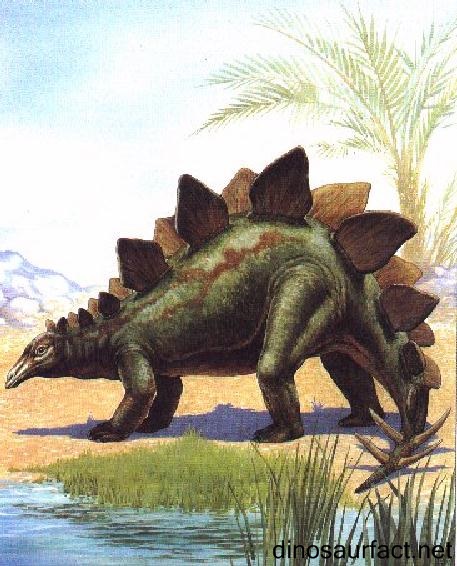
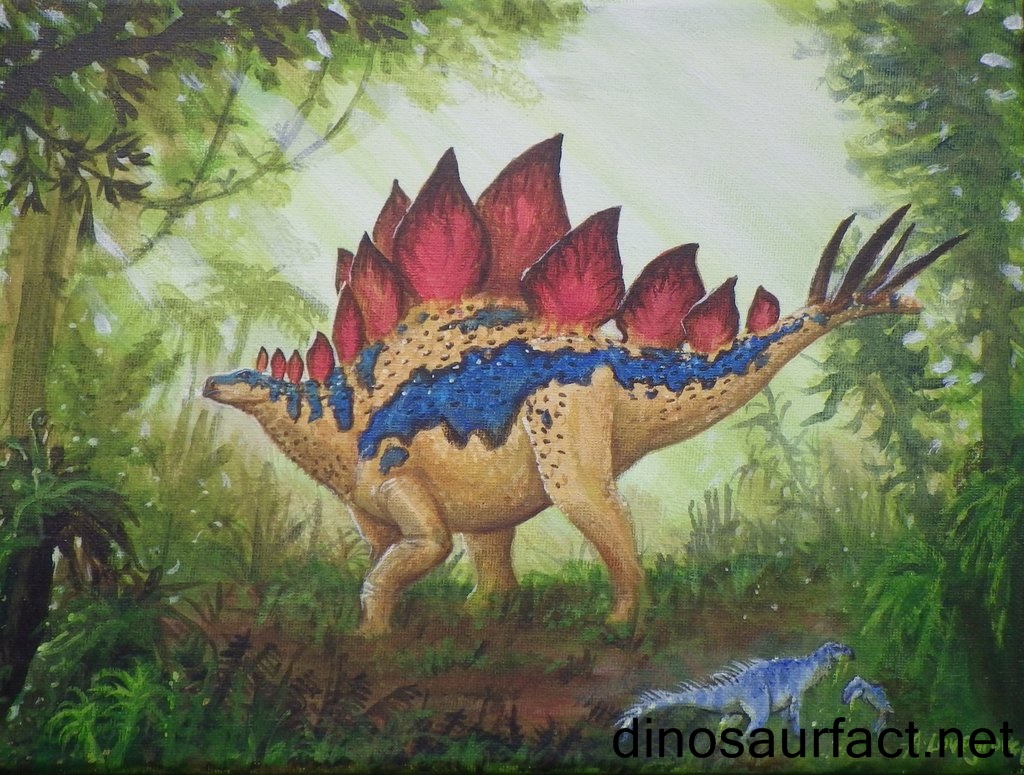
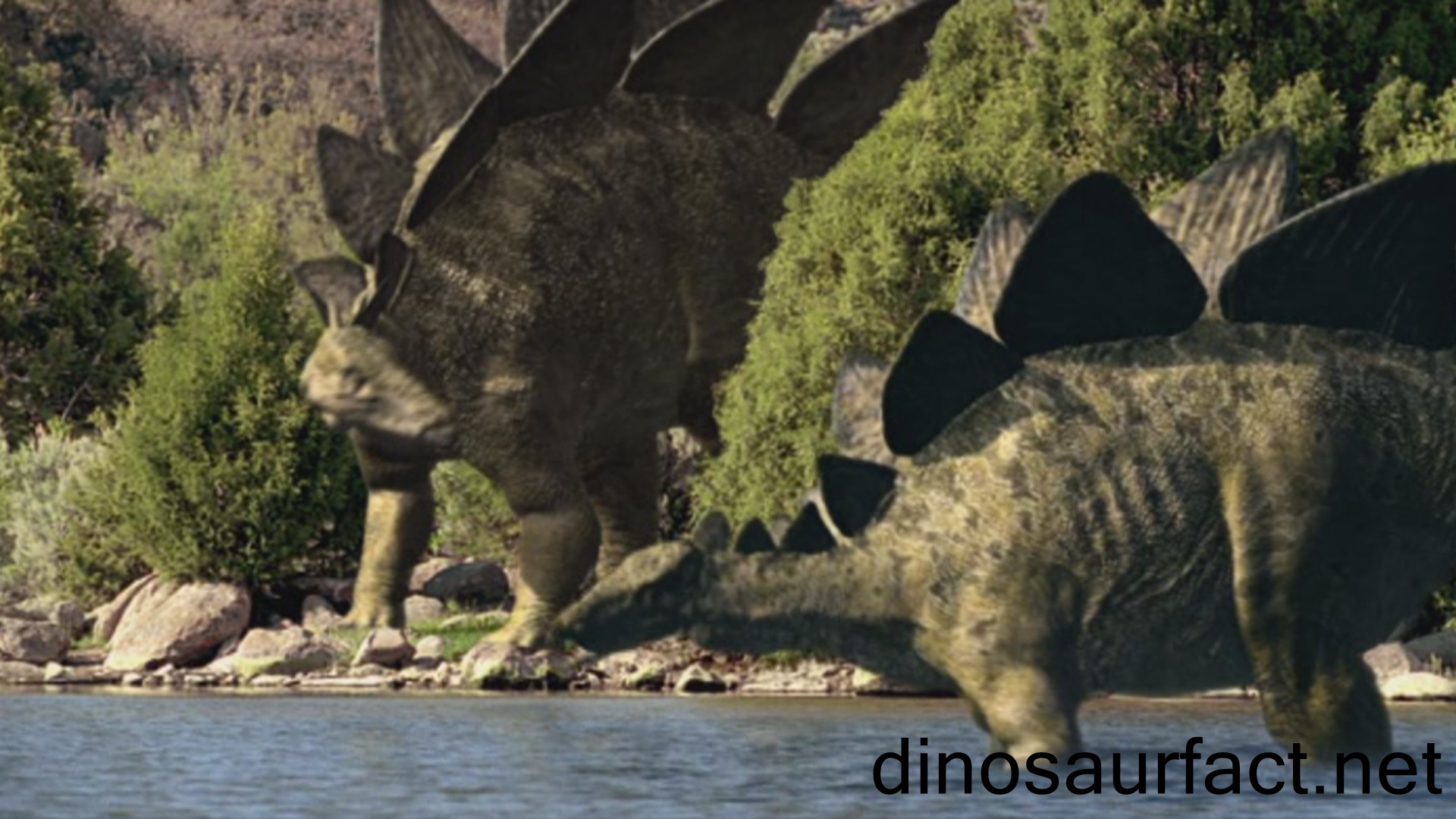
Stegosaurus pronounced steg-oh-sore-us as the name suggests indicates covered lizard or roof lizard. These dinosaurs were believed to inhabit the woodlands of the western part of North America. Stegosaurus was believed to exist during the late Jurassic age approximately a hundred and fifty million years ago. These gentle giants were generally herbivorous by nature. They had a characteristic presence of two rows of large bone like plates on their back and a tail that had spikes. Their head was generally small when compared to their body size. The gait of the Stegosaurus was generally low hung and it had a brain that was the size of a walnut.
The presence of the plates have been believed to be used for defensive purposes as however big the stegosaurus may be there were bigger predators to hunt them. These bony plates were hence providing as much protection possible. Whilst there have been other schools of thought who believe that these plates served to dissipated the heat generated from the large body of the stegosaurus. This mechanism can be very much compared to the cooling mechanism that elephants use with their large floppy ears.
The discovery of stegosaurus itself has quite a bit of history involved in it that is worth mentioning. It scrolls back to the late nineteenth century when the so called bone wars was actually on its peak. The Stegosaurus discovery can be said to be the most distinctive discovery achieved during this period. In fact the appearance of the Stegosaurus fossil was also quite unique so much so that it was given a completely different genus.
Factually the first type fossil of Stegosaurus was discovered in the Morrison formation which was located at a stretch in Colorado. Back in the year eighteen hundred and seventy seven the type fossil was named by Othniel Charles Marsh. Marsh was a noted paleontologist on that era. However initially Marsh was of the idea that he was dealing with a giant prehistoric turtle . He was of the opinion that the bony plates of his prehistoric roof lizard had been arranged flat on its body and served as armor. However it was not very long that his misconception was cleared, thanks to the discovery of more Stegosaurus fossils in the later years. Marsh had by now realized his mistake and then later he properly assigned Stegosaurus in the late Jurassic period.
However fortunately enough the general description of the Stegosaurus was broad enough for Marsh and his colleagues to include various other species under its genus umbrella. Some of the species later turned out to be dubiously named however that shall be discussed at some other article. For now we consider the relevant Stegosaurus species that have been discovered and studied the most till date.
- Stegosaurus armatus is one such example, the name standing for the armored roof lizard. This species originally named by Marsh stood almost thirty feet in length if measured from head to tail. Their plates were relatively small when compared to its other brothers. However they had four characteristic horizontal spikes thrusting out from the tail.
- Stegosaurus ungulates or as the name suggest were the hoofed roof lizard. Marsh named them in the year eighteen hundred and seventy nine. However they were named on the reference to the presence of hooves a specialization that the dinosaurs did not possess. The type fossil referring to this species consists of only a few vertebrae and some plates. Different paleontologists have termed them to be just another juvenile fossil belonging to a juvenile Stegosaurus armatus.
- Stegosaurus stenops as the name suggest was a narrow faced roofed lizard. This species was named by Marsh too approximately ten years after Marsh named Stegosaurus armatus. The length of this species was only seventy five percent when compared to its predecessor and naturally it's plated were comparatively smaller too. However there were far more abundant fossils of S.stenops that were discovered. In fact there is a completely articulated specimen present that belongs to this species.
- Stegosaurus sulcatus was the furrowed roof lizard. It was also named by Marsh back in the year eighteen hundred and eighty seven. Although there have been some confusions regarding the validity of this species but to confirm their existence there however has been a study which conforms to the presence of this animal as a species. It has been believed that one of the spikes which are generally observed in the tail was found in its shoulder.
- Stegosaurus duplex as the name suggests was a roof lizard that possessed two plexus. This species was also named by Marsh in the year eighteen hundred and seventy seven. This should be comically mentioned as the notorious stegosaurus that was believed to be posses' two brains the extra one in its butt. Marsh gave the hypothesis that there could have been a neural crest in the hip bone could be containing that extra brain. This was also believed to be an adaptation to accommodate the small brain.
- Stegosaurus longispinus, basically indicated a long spined lizard which had the same size as that of S. stenops. Charles W. Gilmore, another noted paleontologist, was the person who named this species. There have been scientists who have occasionally pointed out that this type fossil could have been closely related to Kentrosaurus which was another Stegosaurus.
- Of the other few discoveries, the teeth of Stegosaurus madagasceriensis were also found in the island of Madagascar in the year nineteen hundred and twenty six. This discovery has been considered dubious as the Stegosaurus was restricted to North America and the Europe during the Jurassic period.
The reconstructing of the proper Stegosaurus looks on the basis of its fossil was the most difficult thing that paleontologists had to encounter during that period. Another puzzle that remains a fantasy till now is the arrangement and the function of the plates of the Stegosaurus. There has been a recently agreed upon point that these seventeen plates were arranged in alternately fashion and the plates ran down the back portion of the Stegosaurus. Robert Bakker in this context has given the hypothesis that these Stegosaurs plates are loosely arranged on the back of the body and the Stegosaurus had the ability to flop these plates back and forth. This helped them in deterring of their predators.
Just for fun we have a soundclip available for you to hear what a Stegosaurus could've sounded like. Click to the Dinosaur Sounds area to hear it. Please note that the dinosaur sounds are only for entertainment and are not an actual fact.
Index
 Home
HomeExtinct Profiles
 Triassic Dinosaurs
- Jurassic Dinosaurs
- Cretaceous Dinosaurs
 Pterosaurs
 Marine Reptiles
 Dinosaur Extinction
 Earth Timelines
 Hadean Eon
 Antarctica
 Africa
 Asia
Asia Australia
 Europe
 North America - Canada
 North America - Mexico
 North America - USA
 South America
 Basic Groups
 Dino stuff for sale
 Dinosaur Sounds
 Dino Wallpapers
 Dino general FAQ
 Dinosaur Games
 Terra Nova thanks us
 English
 Español
 Wristbands